Tequila Auction Prices: Is Tequila Today Where Whisky Was 10 Years Ago?
Tequila's auction trading is following the path whisky took a decade ago. Prices, activity and supply all point the same way. Here is the data, and what makes tequila's scarcity different.

Whisky took more than a decade to move from a niche collectors' market to a serious secondary market. Premium tequila now looks like it is on a similar path, with a few features that make its case stronger than whisky's was.
This article looks at the auction data side by side. For the wider investment picture, see our main guide to tequila vs whisky as an investment.
In this article we cover:
Tequila's auction prices today match whisky's prices of a decade ago
Auction activity is following the same curve
Four features that make premium tequila scarce
What the agave cycle means for extra añejo
Where tequila differs from whisky
Tequila's auction prices today match whisky's prices of a decade ago
Auction data shows us that premium tequila is trading on the secondary market at roughly the prices whisky reached 10 years earlier.
Spirit | Period | Mean auction price |
|---|---|---|
Tequila | 2021–26 | £88–£177 |
Whisky | 2011–16 | £67–£173 |
Whisky's growth since then has been large. Its auction traded value grew 17-fold between 2011 and 2025, from £507,000 to £8.8 million, based on the same Tequila Reserve analysis.
Auction activity is following the same curve
Our data shows tequila tracking whisky's trajectory on auction trading activity. Plotted on a logarithmic scale and offset by ten years, tequila's line rises in the same way whisky's did in its early years.
The scale of the gap is clear from the latest figures. Whisky's auction activity reached 12,748 in 2025, while tequila's stands at 549. If tequila follows the path whisky took, there is a long way to go.
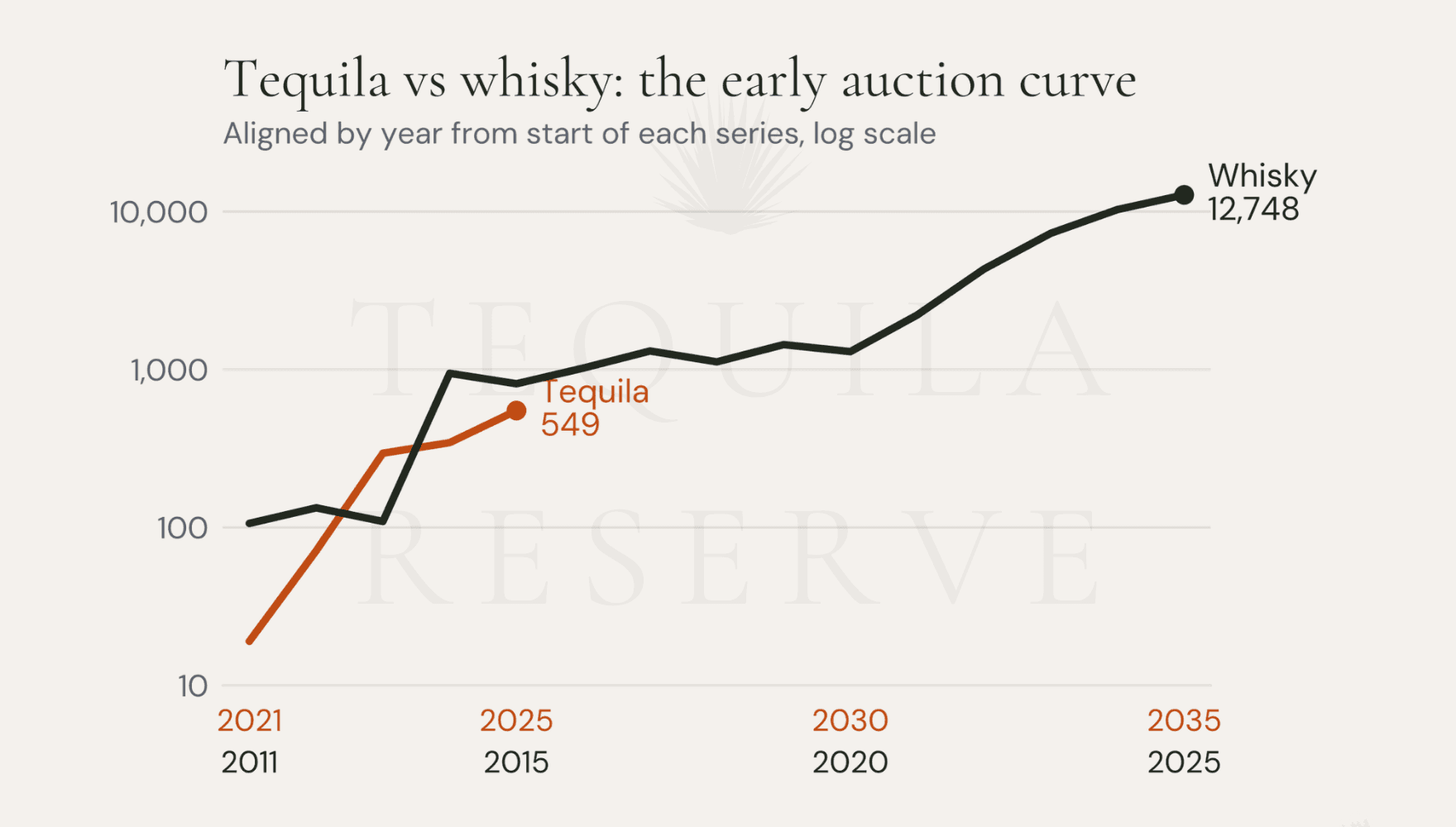
Source: WineFi trade database incl. WineLabs. Tequila: 16 auction houses, 2021-2025. Whisky: 39 auction houses, 2011-2023.
Four features that make premium tequila scarce
Three of these features resemble what made old malt whisky valuable. The fourth has no whisky equivalent.
1. A legal definition of age
The extra añejo category was created in 2006. It requires at least three years in oak barrels of 600 litres or less. The Tequila Regulatory Council certifies production and labelling, in the same way that statute governs Scotch. For buyers, the age statement is a verifiable standard. For more on the category, read our guide to extra añejo tequila.
2. Costly maturation
Ageing tequila in Jalisco is expensive. CLASS puts evaporation losses for tequila in Jalisco at roughly 4–6% a year, against 1.5–2% for whisky in Scottish warehouses.
Most producers do not age their tequila. Those that do tend to bottle as soon as they reach the three-year minimum for extra añejo. Tequila with three or more years in wood is therefore genuinely rare, and the market is under-served. The same dynamics explain much of what makes a tequila barrel valuable.
3. A collector culture around limited releases
Whisky went through this stage around 10 years ago, and tequila is now gaining attention on the secondary market. The clearest example is a Clase Azul Día de Muertos decanter from 2017, one of only 300 made. It originally sold for about $250. In July 2026 a single bottle fetched $35,000 at Sotheby's New York, a new world auction record for tequila, as The Drinks Business and Fred Minnick reported.
Even so, Sotheby's global head of spirits has described tequila's secondary market as still very much in its infancy.
4. The tequila advantage: the agave cycle
Scotch has no equivalent crop constraint. Its only bottleneck is time in cask. Tequila has two: time in barrel and the agave plant itself.
Agave takes six to eight years to mature, so planting decisions made today do not reach the market until the end of the decade. That lag produces sharp boom-and-bust cycles. Agave prices peaked at MXN 34/kg in November 2022, fell to MXN 16.5 a year later, and have sat at MXN 2–9 from 2024 to today, according to Tequila Reserve's analysis of Tequila Matchmaker data.
Agave prices move in long boom-and-bust cycles

Blue Weber agave field price, MXN per kg in 2024 pesos, 1960-2024, with Tequila Matchmaker’s projection to 2032. Source: WineFi analysis, raw data from combined sources: Tequila Matchmaker (TasteTequila.com and participating brands), 1996-2024 and Tequila Matchmaker's own projection. Earlier figures come from a published real-price series drawing on Luna (1992) and Llamas Navarro (2000). Nominal prices were deflated using INEGI's consumer price index (December-on-December inflation, 1969-2025) and IMF/World Bank inflation rates (1960-68).
What the agave cycle means for extra añejo
We are now at the bottom of the cycle. Historically, low prices push farmers towards more profitable crops, which reduces planting. That sets up the next shortage: higher agave prices, then higher production costs, then higher tequila prices.
For extra añejo, the timing matters. Spirit laid down now from low-cost blanco will reach the market alongside extra añejo made during the high-price period that ended in 2024, and ahead of the next price rise. That gives it a structural cost advantage over the stock it competes with. Our guide to how tequila barrel investment works explains how that advantage can be captured.
Where tequila differs from whisky
The comparison has limits. Whisky's auction market is far larger, with 12,748 against 549 in the latest figures. Tequila's secondary market is much younger and thinner. Trends can stall, and past performance is no guarantee of future returns.
What the data does show is a spirit with legally defined age, costly maturation, an emerging collector base and a supply cycle whisky never had. Those are the conditions that supported whisky's rise. For the full side-by-side analysis, return to our tequila vs whisky investment guide.
Frequently Asked Questions (FAQ)
Is tequila today where whisky was 10 years ago?
On auction data, it looks that way. Premium tequila sold at a mean auction price of £88–£177 between 2021 and 2026, close to whisky's £67–£173 between 2011 and 2016. Tequila's auction activity is also rising along a similar curve, although its market is still far smaller and past trends don't guarantee future returns.
How much has the whisky auction market grown?
Whisky's auction traded value grew 17-fold between 2011 and 2025, from £507,000 to £8.8 million, based on Tequila Reserve's analysis. In 2025, whisky's auction activity reached 12,748, against 549 for tequila.
What is the auction record for a bottle of tequila?
In July 2026, a 2017 Clase Azul Día de Muertos decanter, one of only 300 made, sold for $35,000 at Sotheby's New York, a world auction record for tequila. It originally sold for about $250.
Why is aged tequila so scarce?
Four things limit supply. Extra añejo has a legal minimum of three years in oak barrels of 600 litres or less. Ageing in Jalisco is costly, with high evaporation losses. Most producers don't age their tequila, and those that do tend to bottle at the three-year minimum. And the agave plant itself takes six to eight years to mature.
How much tequila evaporates from the barrel each year?
According to CLASS, tequila ageing in Jalisco loses roughly 4–6% of its volume a year to evaporation, the "angel's share". That compares with around 1.5–2% for whisky in Scottish warehouses, which makes long-aged tequila more costly to produce.
How does the agave cycle affect tequila prices?
Because agave takes six to eight years to mature, supply reacts slowly and prices move in long boom-and-bust cycles. Agave peaked at MXN 34/kg in November 2022, fell to MXN 16.5 a year later and has sat at MXN 2–9 since 2024. Historically, low prices reduce planting, which can lead to the next shortage and higher tequila prices, although the timing is never certain.
Where does the tequila and whisky comparison fall short?
Whisky's auction market is far larger and more established, while tequila's secondary market is younger and thinner. Trends can stall, and past performance is no guarantee of future returns. For the full comparison, see our guide to tequila vs whisky investment.
If you are interested in investing in barrels of premium ageing tequila, with a Historic IRR of between 15% and 35% (net, historic transaction records verified by WineFi), you can download our tequila barrel investment guide.
This article is provided for general information and is not personal investment advice. Capital is at risk. Wine and spirit values can go down as well as up, and investments may not perform as expected. Returns may vary. You should not invest more than you can afford to lose. WineFi is not authorised by the Financial Conduct Authority. Investments are not regulated and you will have no access to the Financial Services Compensation Scheme (FSCS) or the Financial Ombudsman Service (FOS). Past performance and forecasts are not reliable indicators of future results. Investments are illiquid. Tax treatment depends on individual circumstances and may change. You are advised to obtain appropriate tax or investment advice where necessary. WineFi is a trading name of WineFi Management Limited.


Ready to Invest in Tequila?
Connect directly with our investment team to discuss portfolio integration, hold periods, and secure your barrel allocation.
© 2026 WineFi Management Limited. All rights reserved. Capital is at risk. Wine values can go down as well as up, and investments may not perform as expected. Returns may vary. You should not invest more than you can afford to lose. WineFi is not authorised by the Financial Conduct Authority. Investments are not regulated and you will have no access to the Financial Services Compensation Scheme (FSCS) or the Financial Ombudsman Service (FOS). Past performance and forecasts are not reliable indicators of future results and should not be relied on. Forecasts are based on WineFi’s own internal calculations and opinions and may change. Investments are illiquid. Once invested, you are committed for the full term. Tax treatment depends on individual circumstances and may change. You are advised to obtain appropriate tax or investment advice where necessary.
WineFi is a trading name of WineFi Management Limited. Registered in England and Wales with registration number: 14864655 and whose registered office is at 5th Floor, 167-169 Great Portland Street, London, United Kingdom, W1W 5PF.