Why Invest in Tequila Barrels Rather Than Bottles?
Bottles are the finished product, barrels are the raw opportunity. Here's why serious tequila investors tend to look upstream.

Topics covered in this article:
When people first consider tequila as an investment, the instinct is often to think in terms of bottles - rare expressions, limited editions, collectible labels. But for those looking at tequila through an investment lens rather than a collector's lens, barrels tend to offer a fundamentally different, and often more compelling, proposition.
The core distinction is simple:
Investing in barrels means buying the spirit earlier in the value chain, before the costs of bottling, branding, distribution and retail margins are layered on top.
Investing in bottles means buying a finished consumer product, where a significant proportion of the price has little to do with the liquid itself.
More of your capital goes into the tequila itself
When you buy a bottle, a meaningful share of what you're paying for is glass, labels, packaging, marketing, distributor margins, retailer mark-ups and, in some markets, import duties. A barrel strips most of that away. What you're buying is much closer to the underlying commodity - the maturing spirit - rather than everything wrapped around it.
You own an ageing asset, not just stored stock
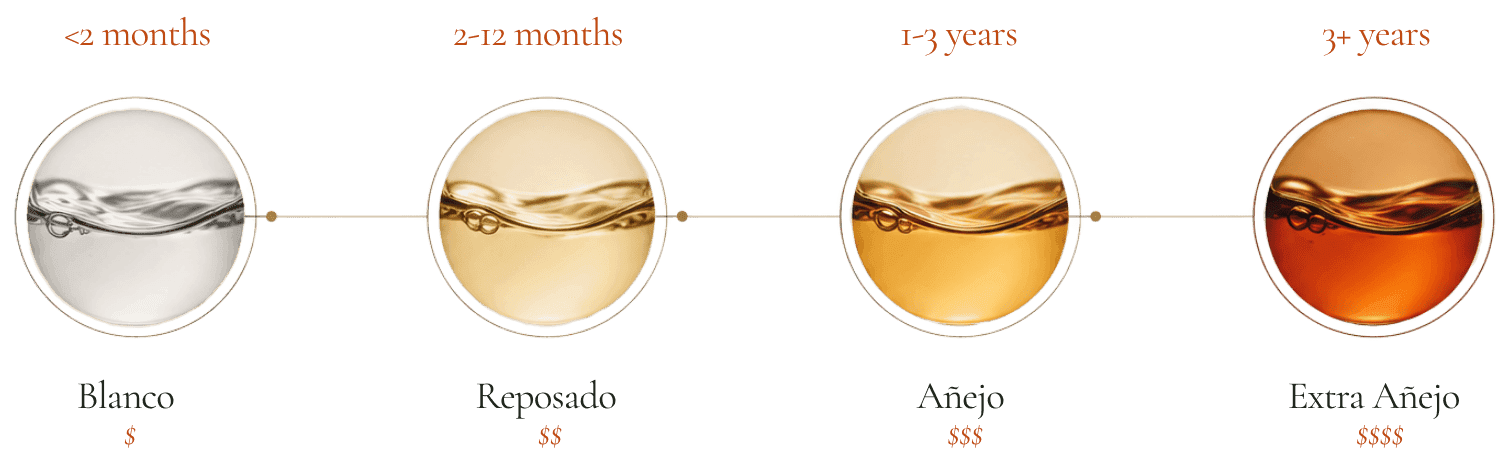
Tequila can progress through classifications as it matures, from Reposado through to Añejo and eventually Extra Añejo, the category reserved for spirit aged beyond three years. The pricing data makes clear why that final step matters most - extra añejo doesn't just cost more, it's where each additional year in oak adds the most value per bottle.
This matters for investors because a barrel isn't simply sitting in a warehouse depreciating - it has the potential to become a more scarce and commercially valuable product purely through the passage of time, as it moves into rarer, longer-aged categories.
Barrels offer far greater optionality
A finished bottle really only has one realistic exit route: finding a buyer who specifically wants that exact bottle. A mature barrel, by contrast, can be sold whole to a producer, brand or bottler; aged further to increase its classification and value; or bottled and private-labelled at a later date. Understanding how tequila barrel investment actually works makes clear just how many of these routes can stay open simultaneously, rather than betting on a single outcome.
Institutional buyers deal in bulk, not bottles
Brands and bottlers need liquid inventory to keep producing. They are far more likely to be in the market for barrels or bulk aged tequila as production inputs than for thousands of individually owned collectible bottles scattered across secondary markets. This means barrel investors are selling into a market with genuine commercial demand, rather than relying solely on collector enthusiasm.
No dependence on one brand's resale market
Bottle investing often amounts, in practice, to a bet that a particular branded SKU becomes collectible enough to command a premium on secondary markets. Barrel investing doesn't need that story. Instead, value can be assessed on more fundamental factors - provenance, producer reputation, age and the quality of the liquid itself, alongside the available supply of comparably aged inventory. It's worth understanding what actually makes a tequila barrel valuable before assuming all barrels are created equal.
Scarcity that develops naturally over time
Mature tequila cannot be conjured up overnight. If demand for older expressions increases, producers need stock that was laid down years in advance - and that stock simply doesn't exist unless someone put it aside earlier. Investors who already hold ageing barrels are, in effect, positioned on the supply side of that potential imbalance, rather than scrambling to source mature liquid after the fact.
The economics can improve with scale
A single 200-litre barrel represents roughly 285 bottles of 700ml, before accounting for ageing losses such as evaporation. The eventual aggregate retail value of those bottles, once bottled and branded, can be substantially higher than the original bulk value of the barrel. It's important to be clear, though, that this theoretical retail value shouldn't be treated as an investor's realistic expected exit price - actual returns depend on the exit route chosen, market conditions and the deal struck with a buyer.
The bottom line
Bottles can make sense for collectors chasing a specific label or story. But for investors focused on the underlying economics, tequila barrels offer earlier-stage exposure, multiple credible exit strategies, and a scarcity dynamic rooted in production reality rather than marketing hype. Before committing capital, it's worth getting familiar with the mechanics of barrel investment and how tequila compares with other cask-based categories such as whisky.
If you are interested in investing in barrels of premium ageing tequila, with a Historic IRR of between 15% and 35% (net, historic transaction records verified by WineFi), you can download our tequila barrel investment guide.
This article is provided for general information and is not personal investment advice. Capital is at risk. Wine and spirit values can go down as well as up, and investments may not perform as expected. Returns may vary. You should not invest more than you can afford to lose. WineFi is not authorised by the Financial Conduct Authority. Investments are not regulated and you will have no access to the Financial Services Compensation Scheme (FSCS) or the Financial Ombudsman Service (FOS). Past performance and forecasts are not reliable indicators of future results. Investments are illiquid. Tax treatment depends on individual circumstances and may change. You are advised to obtain appropriate tax or investment advice where necessary. WineFi is a trading name of WineFi Management Limited.


Ready to Invest in Tequila?
Connect directly with our investment team to discuss portfolio integration, hold periods, and secure your barrel allocation.
© 2026 WineFi Management Limited. All rights reserved. Capital is at risk. Wine values can go down as well as up, and investments may not perform as expected. Returns may vary. You should not invest more than you can afford to lose. WineFi is not authorised by the Financial Conduct Authority. Investments are not regulated and you will have no access to the Financial Services Compensation Scheme (FSCS) or the Financial Ombudsman Service (FOS). Past performance and forecasts are not reliable indicators of future results and should not be relied on. Forecasts are based on WineFi’s own internal calculations and opinions and may change. Investments are illiquid. Once invested, you are committed for the full term. Tax treatment depends on individual circumstances and may change. You are advised to obtain appropriate tax or investment advice where necessary.
WineFi is a trading name of WineFi Management Limited. Registered in England and Wales with registration number: 14864655 and whose registered office is at 5th Floor, 167-169 Great Portland Street, London, United Kingdom, W1W 5PF.